
Welding
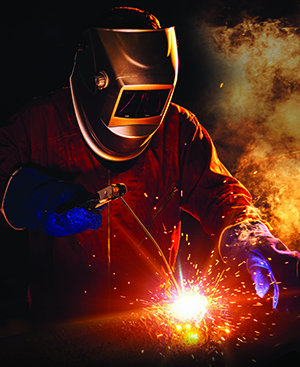
The Welding Technology Program at Trinidad State is expertly designed to equip students with the essential skills and knowledge required for professional careers in welding construction and fabrication. This comprehensive program provides a robust educational experience, combining classroom instruction with hands-on project-based learning under the guidance of an NCCER Certified Instructor.
Program Cost
Choose Your Path
Whether you want a full degree or a fast credential, every TSC program earns you industry certifications and every certificate stacks toward the degree.
AAS Degree
Build comprehensive welding skills — from foundational oxyacetylene and structural welding to advanced MIG, TIG, flux-cored, and pipe welding — complemented by workplace professionalism and core general education coursework in English, math, and communication.
Welding Technology Certificate
Introduces core welding processes — oxyacetylene, plasma cutting, structural, and arc welding — alongside essential construction safety standards.
Where You Can Study
This program is offered at the following TSC campus locations.
Welding Techniques
Oxyacetylene Welding – One of the oldest and most versatile processes, oxyacetylene welding uses a flame from burning oxygen and acetylene gas to fuse metals — ideal for cutting, brazing, and repair work.
TIG Welding (GTAW) – Tungsten Inert Gas welding delivers precise, high-quality welds on thin materials and stainless steel — a highly valued skill in aerospace, automotive, and fabrication industries.
MIG Welding (GMAW) – Gas Metal Arc Welding is a fast, versatile process widely used in manufacturing and fabrication, well-suited for production environments and a variety of metals.
Stick Welding (SMAW) – Shielded Metal Arc Welding is one of the most portable and widely used processes, performing well outdoors and on heavy materials — a staple in construction and structural work.
Flux Core Arc Welding (FCAW) – Similar to MIG but using a flux-filled wire, FCAW is especially effective on thick materials and in outdoor or windy conditions.
Structural Welding – Structural welding joins steel and metal components in buildings, bridges, and large-scale infrastructure, requiring students to meet rigorous code standards under demanding load conditions.
Pipe Welding – A specialized, high-demand skill used in oil and gas, water systems, and industrial piping — requiring precision across multiple welding positions and commanding strong wages in the field.
NCCER & Industry Standards
NCCER Certification
TSC's Welding program is taught by an NCCER Certified Instructor, and students have the opportunity to earn nationally recognized NCCER credentials — a gold standard in craft training accepted by employers across the construction and industrial sectors.
AWS Standards
Coursework is aligned with American Welding Society (AWS) standards, ensuring students are trained to the same benchmarks used by employers and certification bodies throughout the industry.
Workplace Safety & OSHA Practices
Students receive thorough training in workplace safety protocols and best practices, preparing them to maintain a safe working environment and meet OSHA compliance standards on the job.
Industry-Ready Skills
Every aspect of the program — from applied mathematics to hands-on fabrication — is designed to meet the expectations of today's employers in construction, manufacturing, maintenance, and repair.
Welding Technology AAS
Click any semester to see the full course list.
Semester One
Strong welding foundation, covering safety standards and core processes including oxyacetylene, plasma cutting, structural, MIG, and TIG welding.
- OSH 1310 – 10-Hour Construction Industry Standards (1 credit)
- WEL 1002 – Oxyacetylene Joining Processes (4 credits)
- WEL 1013 – Oxyfuel and Plasma Cutting (2 credits)
- WEL 1021 – Structural Welding I (3 credits)
- WEL 1024 – Gas Tungsten Arc Welding I (4 credits)
- WEL 1025 – Introduction to Gas Metal Arc Welding (4 credits)
Semester Two
Welding skills across multiple processes — structural, MIG, TIG, flux-cored, and pipe welding — while building essential workplace professionalism.
- BUS 1021 – Basic Workplace Skills (1 credit)
- WEL 1022 – Structural Welding II (3 credits)
- WEL 1025 – Introduction to Gas Metal Arc Welding (4 credits)
- WEL 2024 – Gas Tungsten Arc Welding II (4 credits)
- WEL 2003 – Flux Cored Arc Welding I (4 credits)
- WEL 2030 – Pipe Welding I (4 credits)
- WEL 2031 – Pipe Welding II (4 credits)
Semester Three
English, math, communication, and a liberal arts elective.
Choose one:
- ENG 1015 – Technical English and Communication
-
ENG 1021 or ENG 1020 – English Composition I / Technical Writing I (GT-CO1)
Choose one:
- MAT 1140 – Career Math
- MAT 1240 – Mathematics for Liberal Arts (GT-MA1)
- MAT 1260 – Introduction to Statistics (GT-MA1)
- MAT 1340 – College Algebra (GT-MA1)
Choose one:
- COM 1150 – Public Speaking
-
COM 1250 – Interpersonal Communication (GT-SS3)
Choose one:
- AGY 2140 – Introductory Soil Science (GT-SC1)
- ECO 2001 – Principles of Macroeconomics (GT-SS1)
- ENV 1111 – Environmental Science with Lab (GT-SC1)
- HIS 1220 – U.S. History since the Civil War (GT-HI1)
- PHI 1012 – Ethics (GT-AH3)
- PSY 1001 – General Psychology I (GT-SS3)
Semester Four
Business, technology, and diesel/hydraulics courses alongside a general education elective.
Choose from the following:
- BUS 1015 – Introduction to Business
- CIS 1018 – Introduction to PC Applications
- DPM 1003 – Diesel Engines I
- DPM 1005 – Heavy Duty Powertrains I
- DPM 1006 – Diesel Fuel Systems
- DPM 1021 – Hydraulic Systems
- DPM 2003 – Diesel Engines II
- DPM 2005 – Heavy Duty Powertrains II
Choose one:
- AGY 2140 – Introductory Soil Science (GT-SC1)
- ECO 2001 – Principles of Macroeconomics (GT-SS1)
- ENV 1111 – Environmental Science with Lab (GT-SC1)
- HIS 1220 – U.S. History since the Civil War (GT-HI1)
- PHI 1012 – Ethics (GT-AH3)
- PSY 1001 – General Psychology I (GT-SS3)
Certificate Curriculum
Each certificate is a standalone credential. Click any certificate to see the full course list.
Welding Technology Certificate
Introduces core welding processes — oxyacetylene, plasma cutting, structural, and arc welding — alongside essential construction safety standards.
Semester 1 (18 credits)
Course availability varies by semester — see below for specifics, or speak with your advisor to plan your schedule.
- OSH 1310 – 10-Hour Construction Industry Standards (1 credit) (Fall semester only)
- WEL 1002 – Oxyacetylene Joining Processes (4 credits) (Fall semester only)
- WEL 1013 – Oxyfuel and Plasma Cutting (2 credits) (Fall semester only)
- WEL 1021 – Structural Welding I (3 credits) (Fall semester only)
- WEL 1024 – Gas Tungsten Arc Welding I (4 credits) (Spring semester only)
Choose one: (4 credits)
- WEL 1025 – Introduction to Gas Metal Arc Welding (Fall semester only)
- WEL 2024 – Gas Tungsten Arc Welding II (Spring semester only)
Semester 2 (20 credits)
Course availability varies by semester — see below for specifics, or speak with your advisor to plan your schedule.
- BUS 1021 – Basic Workplace Skills (1 credit) (Spring semester only)
- WEL 1022 – Structural Welding II (3 credits) (Spring semester only)
- WEL 2003 – Flux Cored Arc Welding I (4 credits) (Fall semester only)
- WEL 2030 – Pipe Welding I (4 credits) (Spring semester only)
- WEL 2031 – Pipe Welding II (4 credits) (Spring semester only)
Choose one: (4 credits)
- WEL 1025 – Introduction to Gas Metal Arc Welding (Fall semester only)
- WEL 2024 – Gas Tungsten Arc Welding II (Spring semester only)
Where You'll Go
Real job market data for the careers our graduates pursue, powered by Lightcast.
Contact Us
Have questions about this program? Reach out to a faculty or staff member.

- TitleDean of Instruction
- DepartmentBUS, CIS, ECE
- LocationAlamosa, Colorado • 112 Main
- Emailemily.hammer@trinidadstate.edu

- TitleFaculty
- DepartmentWelding
- LocationAlamosa, Colorado • 101A Main
- Emailcharles.exley@trinidadstate.edu

- TitleFaculty
- DepartmentWelding
- LocationTrinidad, Colorado • 201 Banta
- EmailRobert.Sanchez@trinidadstate.edu